
What is GAP Insurance?
If your car is written off, your insurer will usually only pay out its current market value, not the amount you originally paid. And because cars can lose value quickly, especially in the first few years of ownership, that difference can easily run into thousands.
That's where GAP Insurance comes in. GAP Insurance (Guaranteed Asset Protection Insurance) helps cover the difference between your insurance payout and either your car's starting value, or any remaining finance balance. If your vehicle is written off due to an accident, theft, fire, or flood damage, GAP cover helps make sure you're not left out of pocket.
Whether your car is new or used, purchased outright, financed, or leased within the last six months, we make it easy to find the right GAP Insurance to suit your needs.
To find out more about GAP, read our comprehensive GAP Insurance guide
Trusted cover
MotorEasy offers 5 star Defaqto rated cover, giving drivers affordable financial protection for extra peace of mind.
Most cars covered
MotorEasy covers most vehicles, including new and used cars purchased from dealerships or private sellers, ensuring broad eligibility for GAP insurance.
24 hour payout
MotorEasy offers a 24-hour payout, ensuring claims are processed and paid within a day of approval.
Save 11% with code TVGAP11
Is my vehicle eligible for GAP Insurance?
GAP Insurance is designed to cover a wide range of vehicles, making it a great option for many drivers. Your vehicle is likely to be eligible if it:
Is less than 8 years old
Has fewer than 100,000 miles
Has an insured value below £75,000
To qualify, vehicles must meet UK specifications, be included in Glass's Guide - an independent vehicle valuation database used to estimate your car's market value - and remain unmodified.
How does a GAP Insurance Policy Work?
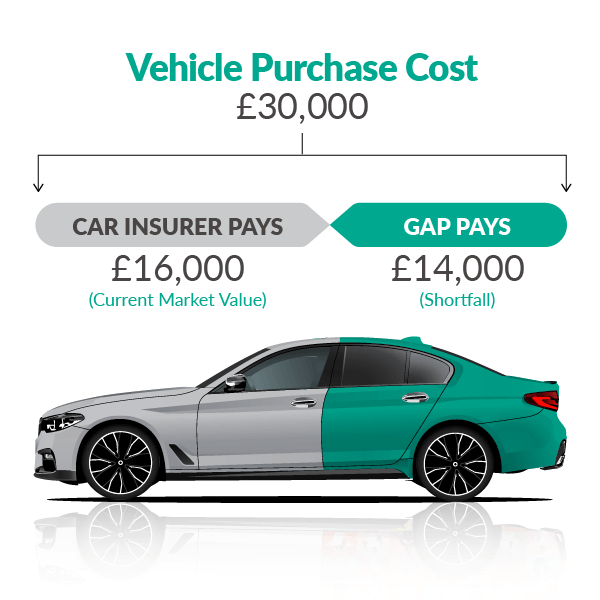
Let's say you buy a new car for £30,000. A couple of years later, it's written off following an accident or theft. By then, its market value may have fallen to around £14,000, which is all your motor insurer is likely to pay out.
If you have GAP Insurance, it steps in to cover the shortfall. Depending on your policy, it will either:
- Top up your payout by £16,000 to match the vehicle's original purchase price or value.
- Pay off the remaining balance on your finance or lease agreement if you owe more than the car is currently worth.
Your GAP Insurance claim limit will be shown in your quote or policy schedule. If your vehicle is written off, it's important to check the claims process in your Policy Document before accepting any settlement offer from your motor insurer. You can access your policy documents through your MotorEasy account.
Why buy GAP Insurance?
GAP Insurance works in different ways depending on the type of cover you purchase, but the idea is the same across the board: it steps in to cover the difference between what your insurer pays out for a write-off or total loss, and the original value of your vehicle.
What types of GAP Insurance are there?
Every driver's situation is different. Whether you bought your car brand new, picked up a reliable used vehicle, or took out a lease, there is a specific type of protection designed to suit your circumstances.
For new and used vehicles purchased within the last 6 months.
Return to Invoice (RTI) GAP Insurance covers the difference between your motor insurer's settlement and the price you originally paid for your vehicle. As the most comprehensive type of GAP cover, it helps protect you from depreciation and reduces the risk of being left out of pocket if your vehicle is written off or stolen.
Return to InvoiceFor new and used vehicles purchased more than 6 months ago or bought privately.
Return to Value (RTV) GAP Insurance covers the difference between your motor insurer's settlement and your vehicle's value when your GAP Insurance policy started. It's ideal for vehicles that no longer qualify for Return to Invoice cover, helping protect you from depreciation and reducing the risk of being left out of pocket if your vehicle is written off or stolen.
Return to ValueFor leased, contract hire and financed vehicles.
If your vehicle is written off or stolen, Contract Hire, Lease & Finance GAP Insurance can help cover the difference between your motor insurer's settlement and the amount owed under your finance or lease agreement. This helps reduce the risk of unexpected costs and being left paying for a vehicle you no longer have.
Contract Hire, Lease & Finance GAPFinance GAP
Save 11% with code TVGAP11
What does GAP Insurance cover?
Theft
Accidental damage
Fire damage
Water damage
A total loss can happen for a variety of reasons, many of which are entirely out of your control as a driver. If your vehicle is written off following an accident, theft, fire or flood, GAP Insurance can help bridge the financial gap.
In addition to covering the core vehicle valuation gap, MotorEasy provides extended benefits to ensure you are fully looked after. MotorEasy also covers factory and dealer-fitted optional extras and contributes up to £500 towards your motor insurance excess (subject to policy terms).
Other GAP Insurance benefits:
- Up to £500 insurance excesses covered.
- Optional extras and accessories covered*.
- Covers European road trips.
- Savings on MotorEasy maintenance and repairs.
- A MotorEasy account for updates 24/7.
*Where factory or dealer fitted.
Why choose MotorEasy GAP Insurance?
Typically, when an incident happens, your insurer will only pay out the current value of your car, not what you originally paid for it. Since cars can lose up to 60% of their value in the first few years, this could leave you facing a big shortfall, especially if you still owe money on your car or are trying to get a vehicle replacement.
With MotorEasy as your GAP Insurance provider, we help cover the difference, ensuring you're not left out of pocket by bridging the gap between your insurance payout and what you paid for your car or still owe on it.
When it comes to safeguarding your finances, you need a provider you can trust completely. MotorEasy offers Defaqto-rated GAP Insurance, straightforward cover options, competitive online quotes and support throughout the claims process.
Save 11% with code TVGAP11
GAP Insurance Limitations & Exclusions
While the level of cover can vary depending on the policy you choose, there are some GAP Insurance limitations and exclusions that apply across all policies. Understanding these exclusions helps set clear expectations about when GAP Insurance will and won't pay out.
GAP Insurance does not cover:
- Claims where you do not hold a valid comprehensive motor insurance policy.
- Vehicles that are not declared an insurance write-off by your motor insurer.
- Situations where you are not the registered keeper or not named on the finance agreement for the insured vehicle.
- Vehicles used as taxis, delivery couriers or emergency vehicles.
- Write-offs that occur while the vehicle is being used for racing, competitions, speed testing, pace-making, reliability trials, or off-road use.
These GAP Insurance limitations and exclusions apply regardless of the type of GAP policy you have in place. However, cover can vary between providers and policies, so make sure to always check the policy documents for the full terms, conditions, requirements and exclusions before purchasing.
How much does GAP Insurance cost?
The cost of GAP Insurance varies depending on your vehicle, the type of cover you choose, and the length of your policy. Because every driver and vehicle is different, the best way to find out your price is to get a personalised quote.
Getting a GAP Insurance quote from MotorEasy takes just a few moments and provides an accurate price based on your vehicle and circumstances.
Save 11% with code TVGAP11
When to Buy GAP Insurance?
We recommend buying GAP Insurance as soon as possible after receiving your vehicle. Vehicles start to depreciate from day one, and you won't be covered until a policy is in place.
If you're buying Return to Invoice (RTI) GAP Insurance, the policy must usually be purchased within six months of receiving your vehicle.
Is GAP Insurance worth it?
Many drivers ask "Is GAP Insurance worth it?" or "Should I get GAP Insurance?". The answer depends on your vehicle, how it's funded, and your financial situation. Below, we break down when GAP Insurance makes sense, when you might not need it, and what to watch out for.
When GAP Insurance is worth it
GAP Insurance is often worth considering if you have a new or low-mileage vehicle, as cars can lose up to 60% of their value within the first three years. If your car is written off or stolen, your motor insurer will usually only pay its current market value, which may be significantly less than what you paid.
If you're leasing or financing a vehicle, GAP Insurance can be especially valuable. In the event of a total loss, you may still owe money on your lease or finance agreement. GAP Insurance will help cover that shortfall, so you're not left out of pocket.
GAP insurance is also particularly relevant for vehicles that depreciate quickly, including many premium marques and electric vehicles. It can also be useful for vehicles with a high theft rate, as theft is a common cause of many write-off events.
When you might not need GAP Insurance
You may not need GAP Insurance if your car is older, lower value, or if you could comfortably afford the difference between your insurer's payout and the vehicle's original price.
Some comprehensive motor insurance policies include new car replacement cover during the first year. If this applies to you, it's worth checking your policy details before deciding whether GAP Insurance is necessary.
When not to get GAP Insurance
GAP Insurance isn't always necessary, and understanding when not to get GAP Insurance can help you decide whether it's right for you.
- If you already have "New Car Replacement cover" - some standard comprehensive insurance policies include new car replacement cover during the first 12 to 24 months of ownership. If your car is written-off during this period, they will replace it with a like for like vehicle, making GAP insurance redundant for that period.
- If you've purchased an older vehicle - As cars get older, their rate of depreciation slows down significantly. This means there is less likely to be a shortfall between what you paid for your vehicle and what your insurer will payout in the event of a future write-off. This is the reason why MotorEasy GAP Insurance focuses on vehicles up to 8 years old and with fewer than 100,000 miles. Beyond that point it would offer limited value.
Buying GAP Insurance: Specialist Provider or Car Dealer
While GAP Insurance is frequently offered by dealerships at the point of sale, it is also available from independent providers such as MotorEasy. Before purchasing, it's important to compare your options for the best price, and value for cover. It may be easier to arrange policies in person with the dealership, but this may not always be the best value cover. At MotorEasy, we pride ourselves in offering a great combination of cover and competitive pricing, so it's always worth exploring your options.
What to watch out for (costs & cover)
Dealer-sold GAP Insurance can be significantly more expensive than policies from independent providers.
You should always check:
- What the policy covers and excludes
- Any limits on claims or excess payments
- Whether you're eligible based on vehicle ownership and usage
Save 11% with code TVGAP11
Which manufacturers can I get GAP Insurance for?
Here at MotorEasy, we provide GAP Insurance for a wide range of manufacturers, from Audi to VW.
Check out some of the manufacturers we cover below, or get started on your quote now .


How to make a GAP Insurance claim
If you think your vehicle may be declared a total loss, it's important to start your GAP Insurance claim as early as possible.
Here's how to make a GAP Insurance claim:
- Check your policy document: Review the claims process in your policy document, available in your MotorEasy account.
- Wait for your motor insurer's decision: Your motor insurer will confirm whether the vehicle is a total loss and provide a settlement offer.
- Start your GAP claim before accepting the settlement: Begin this process before you accept any settlement offer.
- Submit the required documents: Your policy documents will explain what you need to provide.
If you need any help throughout this process, we can guide you.
Common FAQs
Car insurance helps cover the cost of repairing or replacing your vehicle if it's damaged, stolen, or written off. However, any payout is usually based on your car's current market value at the time of the claim, which may be significantly less than the amount you originally paid or still owe on finance.
GAP Insurance (Guaranteed Asset Protection) is designed to cover this shortfall. If your car is declared a total loss, GAP Insurance can pay the difference between your insurer's settlement and either the price you originally paid for the vehicle or the outstanding finance balance, depending on the type of cover you choose.
In simple terms, car insurance covers the value of your vehicle at the time of the claim, while GAP Insurance helps protect you from the financial gap that depreciation can create, ensuring you're not left out of pocket after a write-off.
GAP Insurance is not a requirement for a financed car, but it's highly recommended. If your vehicle is written off or stolen, your car insurance will likely only pay out the current value of the car, which might be less than what you owe on the finance. GAP Insurance covers that difference, helping you avoid any unexpected costs. But remember, it's not just for financed cars - any car can benefit from GAP Insurance.
You can get a GAP Insurance policy at any time, but it's best to arrange it as soon as you buy or receive your car. If you wait too long, especially after a few months or years, the value of your car might have already depreciated significantly, meaning GAP Insurance won't cover as much. It's also important to note that most policies won't cover you if your car is already written off or stolen, so it's good to get it in place early to ensure you're fully protected should the worst happen.
GAP Insurance doesn't always pay the full amount, but it does cover the difference between what your standard car insurance payout is and either the amount you originally paid for the car or what's left on your finance agreement. This means it helps bridge the gap, but it may not cover additional costs like your excess or other fees. It's important to check your policy to understand exactly what's covered.
Shortfall Insurance is just another term used for GAP Insurance - insurance that bridges the gap between your car insurance payout and vehicle value in the event of a write-off or theft.
Yes, GAP Insurance is available in the UK and MotorEasy offers a range of GAP policies to suit your vehicle.
Yes, GAP Insurance can still be worthwhile on a 3-year-old car, particularly if you have a finance or lease agreement, paid a significant amount for the vehicle, or want protection against depreciation.
GAP Insurance costs vary depending on your vehicle, the type of cover you choose, and the level of protection required. Because every policy is tailored to the individual vehicle, the best way to find out your price is to get a personalised MotorEasy quote.
GAP Insurance isn't a legal requirement, but it is worth considering if your standard motor insurer's payout would leave you out of pocket.
We recommend buying GAP Insurance as soon as possible, as cars depreciate in value from day one of ownership.
